


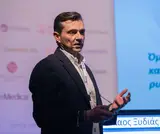
Katerina Meimaroglou, President of the Kestria Executive Board, interviewed Nikolaos Xydias, Vice President & Head of Global Established Pharma for GSK, about the experiences, challenges and leadership lessons that shaped his international career journey. From his early years in finance to leading teams across markets and cultures, Nikolaos reflects on the key decisions, defining moments and personal sacrifices that contributed to his professional growth. He also shares practical advice for professionals aspiring to build an international career and offers valuable insights into the mindset, adaptability and resilience required to succeed in today's global business environment.
What were the key steps in your journey from a local role to international leadership?
Moving from local execution to global strategy requires a breadth of experience that is built progressively throughout a career. It is a step-by-step process of developing leadership capabilities, business acumen, and technical expertise through meaningful, hands-on experience.
For me, the focus was always on embracing diverse opportunities across functions, countries, and leadership environments. Transitioning from finance to commercial roles, working in different markets, and learning from a variety of leadership styles all contributed significantly to my development. I have always believed in gaining depth of expertise rather than moving rapidly through roles without fully mastering them. Building a strong foundation of leadership, knowledge, and experience is essential, and achieving this requires intentional planning, ambition, and a willingness to make difficult trade-offs along the way.
Which early experiences best prepared you for an international career across cultures?
My early years in finance were instrumental in shaping my professional development. During five years in financial analysis, forecasting, and controlling, I gained valuable insight into both the financial and commercial drivers of the business. Equally important was the opportunity to observe and engage with a range of leadership approaches through close collaboration with senior executives.
The defining turning point, however, came when I took on my first international assignment as Head of Finance for Serbia. At the time, my first daughter had just been born, and I commuted between Greece and Belgrade throughout the week. It was a challenging period both professionally and personally, highlighting the realities and sacrifices that often accompany international career opportunities.
Leading a team in a different cultural environment, serving on a market leadership team, and navigating demanding operational challenges proved to be one of the most formative experiences of my career. It reinforced an important lesson that has stayed with me ever since: challenging circumstances, periods of uncertainty, and moments of adversity are often the greatest catalysts for personal and professional growth.
What were the biggest challenges in building an international career, and how did you overcome them?
One of the greatest challenges in building an international career is letting go of familiar routines, established comforts, and a sense of predictability. Success in an international environment requires a mindset grounded in curiosity, adaptability, and a willingness to embrace change. Ultimately, the extent to which individuals are prepared to step beyond their comfort zone is a deeply personal decision.
My experience in Serbia provided a valuable foundation for subsequent international moves. Nevertheless, relocating with my family across different countries and leaving behind an established life was never easy. Throughout this journey, my wife has made significant sacrifices and has been the cornerstone of our family's resilience and success.
For this reason, I always emphasise that pursuing an international career is not solely an individual decision—it is a family decision. Professional ambition must be balanced with personal commitments, and it is essential to remain present and engaged at home, despite the demands of a busy professional life. Professional success loses much of its value if it comes at the expense of long-term personal well-being. By remaining conscious, reflective, and intentional in one's choices, these challenges can be navigated successfully.
How can professionals position themselves for international career opportunities?
I firmly believe that sustainable international careers are built on strong foundations of knowledge, leadership capability, and meaningful experience. In today's environment, it can be tempting to focus excessively on personal branding, visibility, or organisational politics. While these elements have their place, they should complement—not replace—substantive professional development.
In my view, the most effective way to position oneself for international opportunities is to develop deep expertise, cultivate a growth mindset, and consistently demonstrate leadership impact. Networking, relationship-building, and the ability to communicate one's achievements are undoubtedly important; however, they are rarely sufficient on their own to sustain long-term career success.
My advice is to strike a balance between these various elements while maintaining a strong focus on substance: how you lead, how you think, what you know, and your willingness to continue learning. Over time, these qualities become the foundation upon which meaningful international career opportunities are built.
What advice would you give to professionals seeking an international career today?
My advice would be not to rush into an international career, but rather to pursue it with intention and careful reflection. Seek experiences that challenge you, stretch your capabilities, and expose you to situations that require resilience and adaptability. The further you move beyond familiar environments, the more likely you are to encounter uncertainty and adversity—and these experiences often become the most valuable sources of growth.
Throughout my career, I have had the opportunity to navigate a financial crisis as Finance Director in Greece, an operational crisis following an acquisition as Business Unit Director, the global pandemic as General Manager, and the challenges arising from a regional conflict as both General Manager and Cluster Lead. These experiences have profoundly shaped my leadership approach and my broader perspective on business and life. They reinforced the importance of engaging with difficult situations rather than avoiding them, as meaningful growth often occurs in the most demanding circumstances.
Equally important is ensuring alignment with your partner and family regarding the opportunities, sacrifices, and commitments that an international career may require. This should never be taken for granted. Looking back, there are moments when I could have been more mindful of the impact that career decisions had on those closest to me. Professional success is most rewarding when it is achieved alongside strong personal relationships and shared commitment.
Looking back, what would you do differently to accelerate your international career journey?
In retrospect, I would likely have been more open to international opportunities earlier in my career. During my early years in Greece, I could have pursued such opportunities more proactively, but at that stage I was less willing to step away from the familiarity and stability of my established environment.
That said, I was fortunate that circumstances, combined with hard work and strong mentorship, enabled me to develop rapidly within the local organisation. I gained invaluable experience and learned from leaders whom I greatly admire and to whom I owe much of my professional development.
A similar reflection applies to my transition from local to global leadership roles. Having spent two decades in execution-focused leadership positions, I underestimated the value of gaining earlier exposure to global strategy and decision-making. With hindsight, I believe that experience would have enhanced my effectiveness as a General Manager by providing a broader understanding of how global organisations operate and make strategic choices.
Ultimately, the most important lesson is to maintain a mindset of continuous reflection. By regularly evaluating our decisions, learning from experience, and adapting accordingly, we position ourselves for ongoing growth throughout our careers.